Tag Archives: language

Political Parlance

Standard

April 16, 2008

The words we use speak volumes about who we are.  If you’ve ever applied for a job, you’ve felt the pressure of trying to sell yourself as the ideal candidate.  You have to choose your words carefully. 

You want to come across as intelligent, but not arrogant, analytical but creative, someone who works hard but can get down at the office party.  And while appropriate language can take us far, using the wrong words can take whatever impression we’ve created and flush it down the toilet.

Few places are more important for creating a good impression than on the campaign trail.  For months, I’ve sat and watched the candidates for leader of the Free World talking to the American public, delivering speeches, debating, giving interviews. 
Obama_good

The words they choose are important – they offer us glimpses into who they are.  And don’t we all just want to figure out what’s behind the rhetoric?  Research shows the personalities of candidates matter to voters come election time.

James Pennebaker, a social psychologist at the University of Texas, says there are significant and meaningful differences in the language the candidates use. 

For the past few U.S. elections, he’s used a text analysis software program he helped design called Linguistic Inquiry and Word Count (LIWC). 

It calculates how often people use positive emotion words (i.e. love, care, hope, optimism), negative emotions words (i.e. pain, loss, angry, fight), self-references, and big words.

I was especially intrigued by self-reference words:what the use of the pronouns I and we says about someone. 

I was always told not to start too many sentences with I in cover letters lest I come across as too self-focused and not a team player.Not necessarily, says Pennebaker:  I denotes someone who is personal, honest, even more humble than someone who says we a lot.  (Too many I’s though can convey insecurity, depression or arrogance.) 

Pennebaker says that we in political discourse generally means you and shows speakers are detaching themselves from the audience.

While writers, and not the candidates themselves, pen most of the speeches, the argument is they’re so psychologically attuned to the candidate that they write only what would naturally come out of the candidate’s mouth.

So, let’s see what we get when we apply the LIWC method to the candidates. 

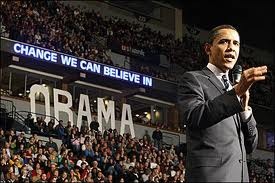
According to Pennebaker, Barack Obama, through his use of language, appears cognitively complex, socially skilled, genuine and sensitive.  What is striking is that he appears more emotionally volatile than the other two candidates when it comes to winning and losing:he tends to say I win, but we lose. 
Hillary

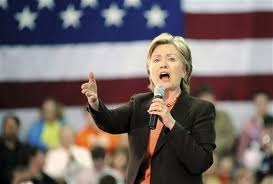
On the other hand, Hillary Clinton and John McCain seem more emotionally stable, using I and we at similar rates after big wins or losses. 

 Clinton tends to use I a lot, as well as positive emotion words, and uses fewer fightin’ words than either McCain or Obama. 

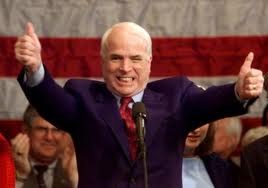
Interestingly, while McCain may come across as emotionally detached, he in fact uses positive emotion words at a higher rate than Obama or Clinton.  According to the analysis, McCain is a really optimistic guy.

Candidates’ language use can also reveal how much they’re spinning. 

Queen’s University computing science professor David Skillicorn has developed a software program that determines the amount of deception in the speeches given by the three current contenders in the U.S. election. 

He defines spin as the way that politicians slightly adjust what they say to appeal to as many voters as possible. 

Skillicorn’s indicators of spin are:  low rates of first-person singular pronouns (I, me, my) and low rates of exclusive words (or, but however).  He says people who spin tend not to create complex sentences or give many details to avoid being asked a lot of questions.

According to Skillicorn’s model, Obama is the king of spin.  McCain is the most forthright, and Clinton speaks more or less candidly, although lately, has been using more and more spin.  
Mccain

Obama’s spin is determined in part by his high use of we, perhaps to distance himself from the message. 

Skillicorn notes this changed after Obama took Wisconsin and Hawaii in late February, having taken a comfortable lead over Clinton and cut into her support by women and union members. 

Obama’s use of first-person singular pronouns then increased dramatically; Skillicorn figured it was because Obama thought he had the nomination. 

Obama’s use of language in his famous speech on race arguably says more about him than his previous speeches. 

Skillicorn found Obama used spin when talking about issues around his pastor:“we need to think about that”, says Skillicorn, translates as “you need to think about that.” 

But James Pennebaker says this speech offered a glimpse of the real Obama.He says Obama was laying out an argument, a world view, almost as if there were no audience:  “It was a ‘this is who I am’ kind of speech.”

So, what does all this speech analysis say about who might win the election? 

Well, the research isn’t irrefutable, but past elections have shown that the candidate who spins the least tends to win (in the Canadian context, Skillicorn found Stephen Harper used the least amount of spin during the 2006 election). 

And whatever you say about George W. Bush, he has (or at least had) a likeability factor.  He used I at much higher rates than either John Kerry or Al Gore, who appeared detached from their audiences.  “Bush may seem like a dufus,” says Pennebaker, “but he always comes across as a human being.” 

And that human factor may be what puts you ahead, because what is a presidential campaign but a glorified job application?  So in your next application, remember:  use I avoid we, speak from the heart, and be positive. 

As it turns out, all your boss really wants is a human being.
Brushing up on Big Words

Standard

Jan. 11, 2008

My brother-in-law, a bright political science professor, recently admitted that whilst expatiating in class, he was about to articulate a complex word, but at the last minute decided to use a simpler one. The word was dichotomy.

He wasn’t sure all the students would understand it, and says he’s becoming more conscious of the words he uses.

It got me thinking about big words.  I recalled a morning a few months ago. I was religiously brushing my teeth while stuffing my head with the day’s news. A story I heard made me stop mid-brush.  It was about serial killer Robert Pickton.

word

The defence was trying to prove that his IQ was below average. But in a test, Pickton could define words like lugubrious, pilfering, wildebeest and dromedary.  Huh?  This wasn’t the vocabulary of a simpleton. Pickton reasoned that he “knew animals”.

I reasoned that the average bloke on the street probably recognizes half of those words. And I felt I wasn’t doing a good enough job incorporating complex words into my daily conversations.

The English language is growing, bursting with new creations and a steady parade of words from other languages. So why, as English approaches its millionth word, do I feel my own vocabulary isn’t growing along with it?

After all, I love words.  I really do.  When I lived in Germany, I quickly boosted my German vocabulary using a very simple method:  sticky notes.

At the end of the day, I gathered up the new words I’d discovered and wrote them on one half of a yellow sticky note.  On the other half, I wrote simple definitions.  I stuck it to my bathroom mirror, figuring I could learn them while I brushed my teeth (really, what else do you do?)  One sticky note became two, then three and four until the whole side of the mirror was plastered with words.

My German roommate was thrilled because it boosted his English vocabulary.  The system proved so successful, I made new vocabulary notes to bring with me on a bike tour.  Whenever I got bored of cows and sunflowers, I learned a new word.

Back in Canada, I continued to feed my hunger for words.  Whenever I came across a word I didn’t know, I jotted it down.  The words I might actually use in daily conversation made the sticky note short list, words like: soporific, irascible, turpitude. 

I stuck it to my bathroom mirror and each time I reviewed the list and recalled the definitions, I flashed myself a toothy grin (my teeth and vocabulary were mutually getting more brilliant).  I puffed with pride when I casually dropped a nugget into conversation.  That remark was so insensate, I’d say.

smile

Our vocabulary acquisition, I realize, naturally drops off as we leave school.  It’s not that we don’t learn new words. There are scrumptious words all over the place, ready to be picked up ingested.  It’s just that fewer of them seem to be rolling off the tongues of the general populace.  Maybe they’re just stuck in our heads.

A media trainer for more than twenty years,Barry McLoughlin teaches people to simplify their message.  He too is noticing big words are dropping off.  McLoughlin says politicians used to hide behind a wall of complicated words.

Joe Clark was known for his loquaciousness, referring to Canada as a “symmetrical confederation”.

Richard Nixon buried his message in cluttering phrases.  McLoughlin says media and advertisers, attuned to shorter attention spans, are forcing increasingly simpler messages.  In the past forty years, an average TV sound bite has shrunk from 42 seconds to seven.

“Vocabulary isn’t necessarily prized in today’s society,” says McLoughlin.  “People are embarrassed to sound like a policy wonk or an egghead, so they use simpler words.”  He says politicians can’t afford not to simplify their message:  if they don’t, the media will.

Barack Obama is someone who employs small words to great effect, urging Americans to look past “red states” and “blue states” to see a United States.  On the other hand, George W’s use of simple words is just, well, wrong on so many levels.

It’s not only the media; technology is also encouraging us to fit fewer words onto smaller screens, write more emails faster. As we try to get the message out quickly, we generally choose words that are most familiar to us.

“I think it’s a troubling sign in a way,” says McLoughlin.  If you’re shrinking your vocabulary, you’re undermining the quality of dialogue you’re having, and that harms the quality of relationships you have.”

A strong vocabulary allows for nuance, extremely important in diplomacy and leadership positions, he says.  Young people who are growing up without the ability to have a sophisticated vocabulary to calibrate what they want to say, undermine their ability to communicate.

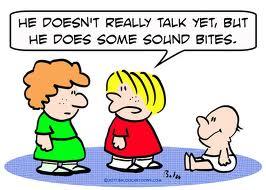
John Serembus, a Philosophy professor at Widener University, is noticing a shift.  For years, he’s taught in “sound bites” to deal with shorter attention spans.  He teaches for ten minutes, stops for questions and a joke, teaches for ten minutes – you get it.

Sound_bites

Lately, he’s noticing that vocabulary is becoming an issue.  A student in his logic class didn’t fare well on a test, admitting he didn’t understand the material because he couldn’t follow the “big words” used in the lecture.  It turned out they were words like implication, hypothetical and consistency.

“Needless to say I was taken aback.  But as I thought about it, I realized that he probably never encountered those words until now,” says Serembus.“As a result,” he says, “I still use the words I want to use whether they are ‘big’ or not, but I do a lot of paraphrasing in simpler terms.”

And now, so many Canadians speak English as their second or third language.I often adapt my language for non-native speakers, andI wonder what kind of long-term effect this will have on our vocabulary.

Now I know there are those who will say au contraire, our vocabulary ain’t shrinking.

Language expert David Crystal says he hasn’t noticed any particular change in word length over the past decade.Yes, sentences have become shorter, he says, but that can create more reliance on the words selected, which can actually get longer.

Crystal says we tend to underestimate vocabulary sizes. Most people think the average size of a person’s vocabulary is a few thousand words, whereas it is actually tens of thousand.

It’s hard to know any of this for sure, though, because as Crystal says:”Vocabulary (by comparison with grammar and pronunciation) remains a hugely neglected topic of linguistic study…It’s the scale of the exercise which is so off-putting.”

In the meanwhile, I shall do my utmost to quaff from the fountain of English.  I’m going back to my sticky note—brushing method.

Vocabulary, like teeth, needs to be kept in good working order to keep its bite.

Chinglish: Lost in Translation

Standard

October 26, 2007

Viewpoint-8

I’m in China, covering the Women’s World Cup of soccer for CBC Radio. It’s another late night and I’m resorting to room service to quell the rumbling in my tummy. But, scanning the menu, I’m not at all sure about the offerings: stuffed fatty meat pork makes me squirm. Slobbering chicken, lion head or cheese melting in ham parcel…I’m not sold. 

I opt for the complimentary apples on my table – at least I know what I’m getting. 

English mistranslations of food dishes are especially rampant in China. My favourite example comes through the dietitian for the Canadian women’s soccer team.

For obvious reasons, the players were very careful not to be too experimental with food. Chicken is usually a safe bet, but not when the dish is translated as the fragrance explodes the cowboy bone. That could have been too, well, explosive.

Other examples of mistranslations abound. A massage therapist advertises: Relex your tired of bady; a toilet for a disabled person is labeled Deformed man toilet; a slippery road is marked Beware, the slippery are very crafty (but they are!). 

Drinktea is hung on a shop door to mean it’s closed (it also means resting in Mandarin). 

Yes, Chinglish is the weird and wonderful result of an English dictionary colliding with Chinese ideograms that often have multiple meanings. 

These linguistic delicacies may well stay in China, but some experts say Chinglish words are zipping around the globe, even working their way into the English language.

The Global Language Monitor tracks and analyzes trends in Global English. Its president, Harvard-educated linguist, Paul Payack, says the Chinglish phenomenon is helping drive the globalization of the English language, contributing up to 20 percent of Global English words. 

Payack says the rate has increased in the past several years because of China’s rising number of English speakers and economic boom. The surge in Internet users has allowed for the free flow of Chinglish. 

In its most recent annual survey, GLM selected the top Chinglish words: No noising (quiet, please!), airline pulp (food served on a plane), jumping umbrella (hang-glider) and question authority (information booth, interestingly enough).

I decided to take some local words back home with me, stuffing them into my already bloated suitcase:  Financial Supermarket (what better word for one store offering stocks, insurance and real estate services?) and Super Brand Mall (only top-end items, please).

Paul Payack says unless a word is on paper, the Oxford English Dictionary doesn’t count it, but he insists the real language is what’s spoken and what’s used on the Internet.

“Maybe only five percent of Chinglish words will stick around,” he says, “but that’s a lot.” He expects the language cycle will go into high gear during next year’s Beijing Olympics.

Viewpoint-7

The rising influence of China is coming not only through Chinese-influenced English, but also through its more famous export: Mandarin, the most widely spoken language on the planet. And beyond China’s borders, tens of millions of people are now picking up scribe and learning to ink the ideograms. 

University of Victoria linguistics professor Hua Lin says “if Mandarin Chinese ever becomes the first choice of a second language to learn, as English has been, there is…less of a chance for these Chinglish expressions to survive or make significant impact.” 

Meanwhile, China’s biggest cities are intent on sweeping the streets clear of unintelligible Chinglish translations.  Beijing has launched a campaign to stamp out bad English in time for its international debut at next year’s Olympics.  

At Shanghai’s Foreign Languages Institute, a bespectacled Zhang Jiani has spearheaded a student initiative to clean up English on menus, in taxis, shops and banks.

She’s an accounting student, but says this is her civic duty: “I think most of the students here have some English skills and I think it’s our responsibility to do something for the city.”  She says they must, if Shanghai is to market itself as a truly international city.

So, once every few weeks, she meets up with a group of students to trek through designated parts of the city. Equipped with electronic dictionaries, they studiously note any suspected mistranslations.They get the correct wording from a professor, then deliver it to the perpetrator who, they hope, makes the correction.

Drinktea may mean closed for business, but this up and coming generation of Chinese will work until the worst of the Chinglish is laid to rest.

The Business of Language

Standard

August 6, 2007

It’s a languid summer afternoon and I’m tasked with fashioning a light radio piece on what not to wear to work. Two stylish men lolling outside a Bay Street office tower are my first victims.

One of them tells me that men wearing lycra bike shorts in the office, especially before morning coffee, is utterly unacceptable. He grimaces, chortles, then becomes serious.

He says what’s worn in the office has morphed over the past couple decades. It used to be that suits and ties were the norm, but the dot-com revolution changed all that by going ultra casual. Nowadays, jeans are paired with open dress shirts and blazers. 

Biz_photo

“We’re expected to be everything to everyone,” he sighs. And that made me think: fashion is just one form of expression that’s adapted to a society pressuring us to be all that we can be, and more.  

Just like the attire we wear sends out different messages, the language we use in the world of business has also taken on multiple meanings.  In an age of globalization, business (wo)men are having to supersize: provide more to a demanding customer. 

Take emails, for example.

Marketing professor at Queen’s University, John Pliniussen, says we’re still expected to stick to a conventional letter format with proper syntax, capitalization, and salutations for professional communication. However, there’s also an expectation we know when to send a cool, flippy email to show our more social side.  

He tells me he’s just finished sending an email to an MBA student, half formal – answering career queries – half chatty, ending off with an emoticon. Pliniussen says that nowadays, clients and audiences are much more diversified, composed of different age groups, genders, and ethnic backgrounds.

To properly address those audiences, he says: “You have to understand more the power of colours, words, numbers and nuances.”  He adds that we’re expected to be able to flow into and out of different modes of communication on demand. 

That’s not a bad thing. This linguistic dance gives value to a wide range of communication skills and keeps us on our toes. 

The language of business also shows its multiplicity in the lingo related to technology. Lingo develops with every generation, evolving with what Pliniussen calls gecomacts (generational communication activities). 

Every new generation develops its own unique expressions that help brand it, based around activities. It’s just that now, there are so many ways to communicate with the written word.

Each innovation supplies its own language: the internet, blackberry, cell phone, and now Apple’s new iPhone, which will likely generate its own lingo. They’re all ways we can communicate with customers and colleagues, tailoring messages appropriately.

Buzz_words

Another way in which business language refuses to be buttonholed into one fixed meaning is buzz words.

They’ve long been used to represent an industry’s philosophies and vision, but an advertising insider says that ever since ‘branding’ came on the scene in the mid-1990s, they’ve really taken off, some even jumping into the mainstream. In this sense, buzz words are used to convey a desired image, to sell people on an idea or product. 

“Buzz words are simply a new way to express an idea that is actually common sensical but gives the impression that you own it,” says the advertising insider.  

She says they’re more important than ever in an era where marketing has become such a science, where more and more people come equipped with marketing degrees to deal with savvy, scrupulous customers.

But the problem with buzz words is that they can have so many meanings, they can become meaningless: vague words that mask unformulated decisions and ideas.  

What do ‘synergistic’, ‘value-added’, ‘blue sky thinking’ and ‘shifting the paradigm’ really mean? ‘Moving forward’? Where else would you want to move?Why say ‘ideate’ when you mean ‘think of ideas’? 

My personal favourite is an advertising industry expression: ‘strategic integration and executional synergy across all communications’. Translated: don’t waste money and make sure your message is consistent. So why don’t people just say that??

Buzz words are the epitome of trying to prove we’re all things to all people, a push to show we’re knowledgeable – even when we’re not.

Are today’s buzz words going too far in the quest to impress:  are we selling out our language? 

Adopting new ways to be creative reflects a changing society, but there’s still a need to retain meaning. The purpose of language, after all, is to make oneself better understood.

In the early days of my journalistic schooling, I was taught that a journalist’s job is to communicate in the clearest way possible. I frequently comb through media releases, looking for the ‘real’ words tucked behind buzz words and other meaningless expressions — words that communicate something substantial about the issue at hand.

Purposeful words are rare, therefore coveted. Communication that gives meaning to every word lays thoughts and emotions bare, with no words to scamper behind.

I advocate a real economy of language. It just makes good business sense.